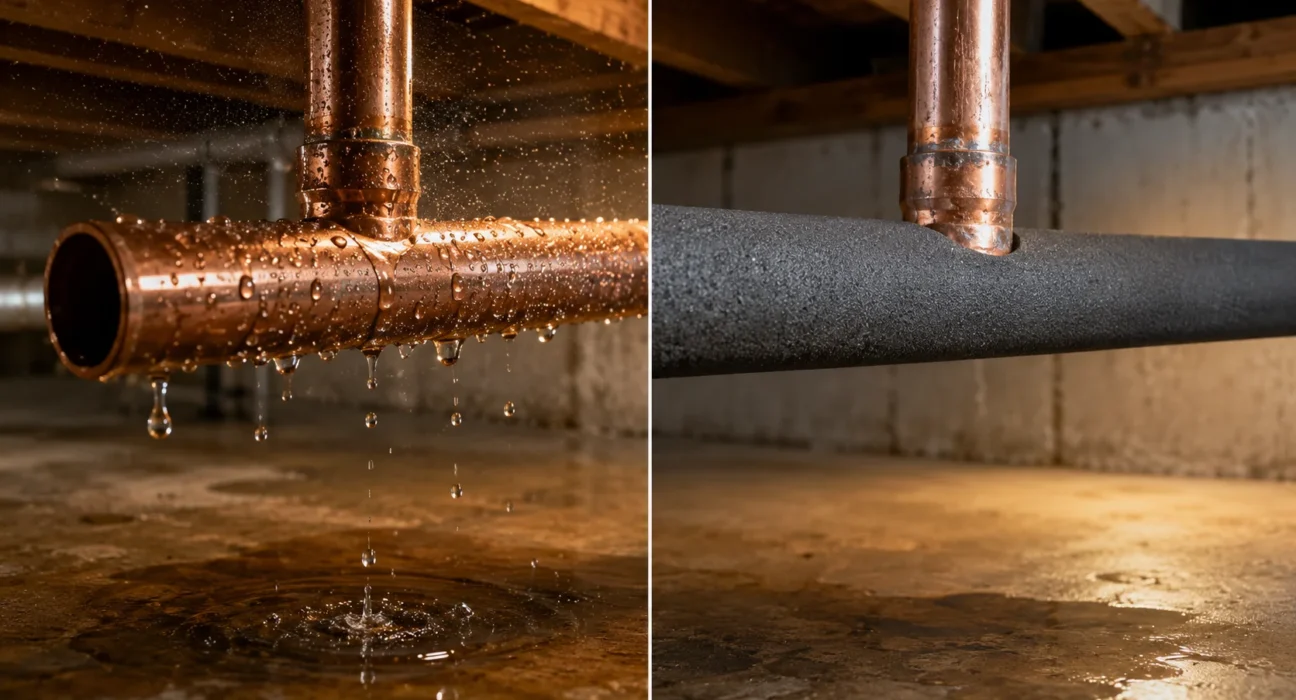
In month of Auguest, USA home owners face an issue in dripping off the cold-water pipes overhead or toilet tank become sweat puddles onto the floor due to the pipe condensation, not a leak. It is normal physics. But ignored long enough, it can rot joists, ruin drywall, and grow mold. Pipe condensation is one of the most common seasonal moisture issues, but homeowners should also watch for other problems covered in our guide on Summer Plumbing Tips for Homeowners in the United States.
In this blog, we have explained exactly why it happens, how to know whether what you are seeing is condensation or a real leak, and how to fix this issue on your own in four levels.
Why Do Pipes Sweat in Summer?
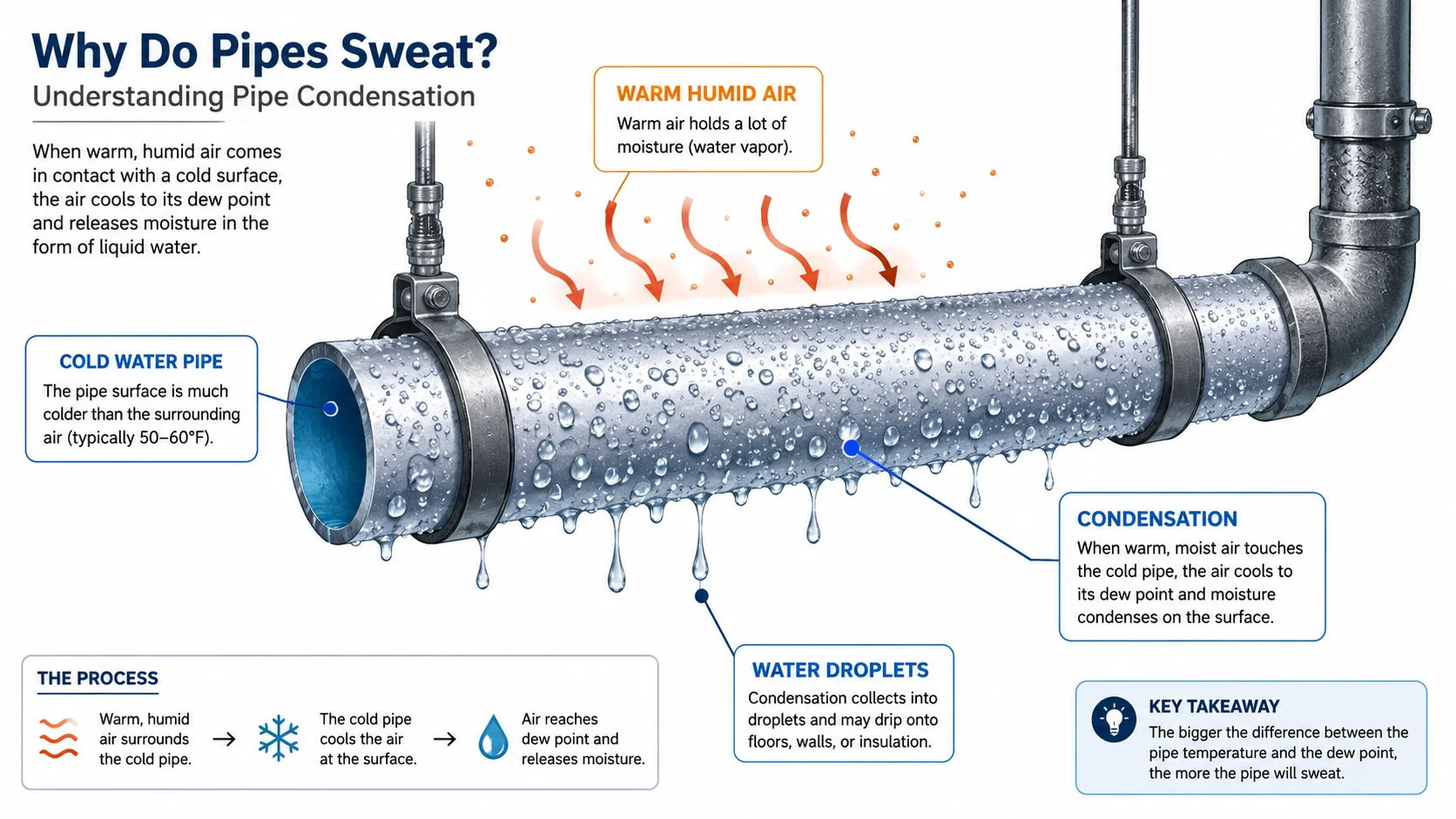
Cold-water pipes carry water that’s usually 50-60°F year-round. If you want to know about the best pipes in plumbing in cold read our blog. In summer, the air around those pipes especially in unconditioned basements, crawlspaces, or behind toilet tanks is warm and holds a lot of moisture. When that warm humid air touches the cold pipe surface, water vapor condenses into liquid water, just like droplets forming on a glass of iced tea.
The temperature at which this happens is called the dew point. When the pipe surface is below the dew point of the surrounding air, condensation forms. The more humid the air, the higher the dew point, and the more dramatically pipes sweat.
This is why you don’t see it in winter, the air is dryer and the pipe-to-air temperature difference is smaller. Pipe condensation occurs when warm, moisture-filled air comes into contact with a cold water pipe that is below the surrounding air’s dew point temperature.
Understanding Pipe Condensation
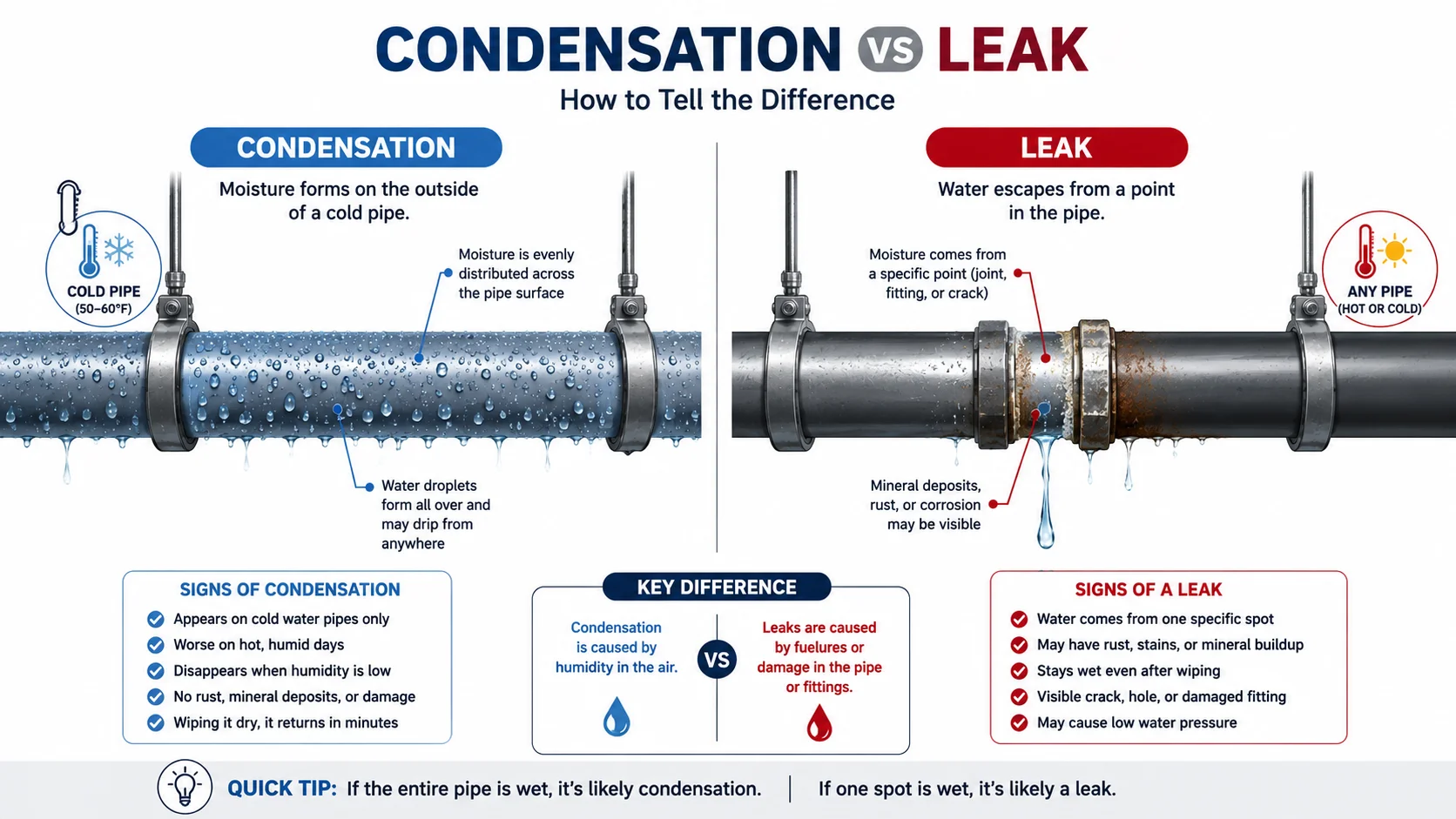
This is the most important diagnostic step. The two look identical at first glance — moisture on a pipe — but the fixes are completely different.
Signs it’s condensation:
-
- The moisture is on the outside of the pipe, evenly distributed across the cold surface.
-
- It worsens on humid days and disappears on dry days.
-
- It’s only on cold-water pipes — never hot-water pipes.
-
- It increases when the AC is running heavily (cooling the pipes further) or when no one’s been using cold water in hours.
-
- The pipe itself is sound — no green oxidation, mineral deposits, or cracks.
-
- You can wipe the pipe dry and within minutes it re-forms with droplets.
Signs it’s a leak:
-
- The moisture comes from a specific point on the pipe — usually a joint, fitting, or stress point.
-
- Mineral deposits (white, green, or rust-colored) are visible at the wet spot.
-
- The pipe is wet but the surrounding pipes are dry.
-
- Wiping the pipe dry leaves it dry for a long time, then drops form again at the same point.
-
- A pinhole hole or hairline crack is visible.
-
- Water pressure in the house has noticeably decreased.
Why Sweating Pipes Are Worth Fixing
If condensation drips happen continuously, day after day, for months in summer, it can effect in this way
Structural Damage to Wood Framing
One of the most serious consequences of sweating pipes is wood rot. Floor joists, wall studs, and other structural members that remain damp for long periods can develop fungal growth that breaks down wood fibers. Over time, repeated summer condensation may weaken structural components and compromise the integrity of the home.
Drywall and Insulation Deterioration
Most homeowners first notice sweating pipes when they see water droplets forming on exposed basement plumbing or puddles developing beneath a toilet tank. In many cases, the problem goes unnoticed until paint begins peeling, drywall starts staining, or insulation becomes damp.
Increased Risk of Mold Growth
In our experience, mold growth is one of the most common long-term consequences of untreated pipe condensation. Basements, crawl spaces, and utility rooms with poor ventilation often show visible mold growth after months of repeated moisture exposure.
Floor Damage Around Toilets
A sweating toilet tank can slowly drip water onto the bathroom floor. While the damage may go unnoticed initially, years of repeated moisture exposure can rot the subfloor and lead to expensive repairs beneath finished flooring.
Permanent Water Stains
Condensation dripping from pipes or fixtures can leave permanent water stains on ceilings, walls, and other finished surfaces. These stains often require repainting or replacement of affected materials to restore the appearance of the home.
Cause Ignoring Sweating Pipes
Although pipe sweating may seem harmless, the long-term effects can include structural deterioration, mold remediation expenses, damaged finishes, and reduced energy efficiency. Fixing sweating pipes early is usually far less expensive than repairing the moisture damage they can cause over time.
Fix Level 1: Foam Pipe Insulation
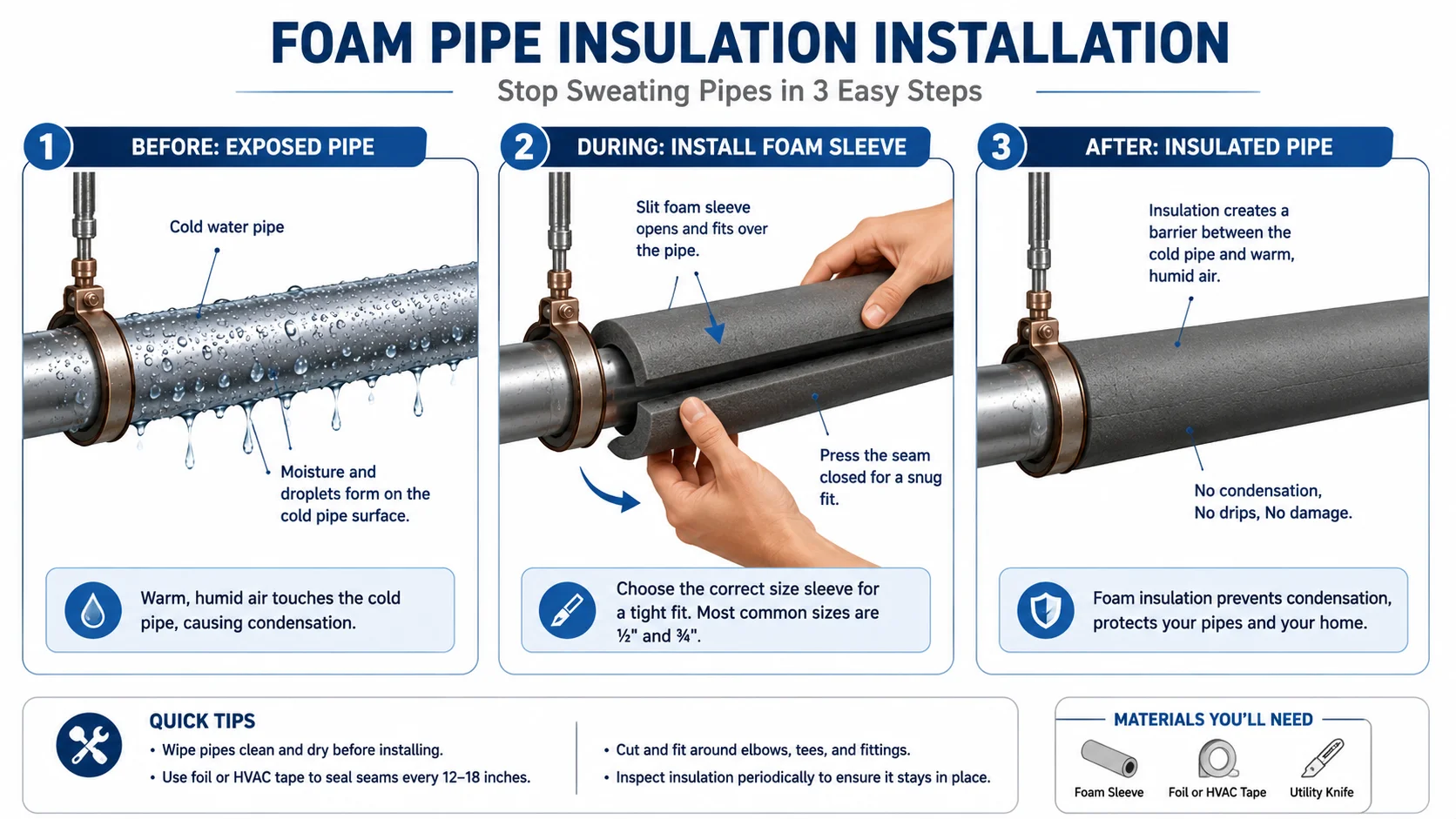
For cold-water pipes in basements, crawlspaces, or any unconditioned area — foam pipe insulation sleeves solve the problem completely. Slit foam tubes slip over the pipe and self-seal. The foam barrier prevents warm humid air from touching the cold pipe surface, so condensation can’t form.
Materials:
-
- 3/8-inch wall thickness foam sleeves (sold in 6-foot lengths at any hardware store, $1-3 each).
-
- Match the foam’s inner diameter to your pipe (½-inch and ¾-inch are the most common residential sizes).
-
- A utility knife for cutting around fittings and elbows.
Installation:
-
- Wipe the pipe completely dry.
-
- Cut foam sleeve to length for each straight section.
-
- Slit open the sleeve along its pre-cut seam, slip it over the pipe, and press the seam closed.
-
- Tape the seam with foil tape or HVAC tape every 12-18 inches for security.
-
- At elbows and tees, miter-cut the foam to fit around fittings and tape the gaps.
Fix Level 2: Toilet Tank Insulation
A sweating toilet tank is its own special problem because foam sleeves don’t fit. Two solutions:
Option A — Tank liner kit ($15-25):
A pre-cut foam insulating panel that adheres to the inside of the tank. You shut off the water, drain the tank, dry it thoroughly, and adhere the foam panels to the tank walls. The foam insulates the porcelain from the cold water inside.
Option B — Anti-sweat mixing valve ($60-150 + installation):
Installed on the toilet’s supply line, this valve mixes a small amount of hot water with the incoming cold water, raising the tank’s water temperature to about 70°F — above the dew point. The toilet stops sweating entirely. Best for severe cases where tank liners aren’t enough, or in bathrooms with chronic moisture.
Fix Level 3: Reduce Humidity in the Space
If condensation is forming everywhere — not just on pipes, but on cold floors, basement walls, AC ductwork, and metal surfaces — the underlying issue is too-high humidity. Insulating individual pipes alone won’t stop it.
Aim to keep basement and crawlspace humidity below 60% RH. Tools:
-
- A hygrometer measure your current humidity. Don’t guess.
-
- A basement dehumidifier ($150-400 for a quality unit). A 35-50 pint/day unit handles most basements. Look for Energy Star certified and a built-in pump for continuous drainage.
-
- Address bulk moisture sources first: fix any plumbing leaks, redirect downspouts away from the foundation, seal cracks in foundation walls, and ensure the dryer vent is properly routed outside (not into the basement).
-
- Encapsulate dirt-floor crawlspaces with a heavy vapor barrier. Crawlspace encapsulation is one of the highest-ROI projects for any home with chronic humidity issues. Cost: $3,000-8,000 depending on size.
Fix Level 4: Address the Root Cause (Air Sealing)
In some homes, the real source of condensation is warm humid outdoor air leaking into cool indoor spaces (or vice versa). Air sealing the building envelope:
-
- Sealing around rim joists with foam board and caulk.
-
- Closing crawlspace vents (if encapsulating).
-
- Sealing penetrations through walls and floors (where plumbing, electrical, and ductwork pass through).
-
- Insulating the rim joist area with closed-cell spray foam.
This is bigger-picture home performance work and is best done by a licensed insulation contractor or energy auditor. But the payback shows up in moisture reduction, lower cooling bills, and improved comfort.
What NOT to Do
A few common mistakes:
-
- Don’t wrap pipes in cloth or paper. It absorbs moisture and stays wet, accelerating rot of surrounding wood.
-
- Don’t ignore drips and let them puddle. Water on wood is the cause of nearly all the damage you’re trying to prevent.
-
- Don’t insulate hot-water pipes thinking it solves the problem. Hot pipes don’t sweat. Insulating them helps energy efficiency, but it’s not the cure for condensation.
-
- Don’t run a dehumidifier without addressing leaks. If water is constantly entering the space from outside, no dehumidifier keeps up.
Frequently Asked Questions
Why do my pipes sweat only in summer?
In summer, warm humid air condenses moisture when it touches cold-water pipes whose temperature is below the dew point of the air. Winter air is dryer and pipe-to-air temperature difference is smaller, so condensation rarely forms.
Is pipe condensation a leak?
Condensation forms on the outside of pipes from moisture in the surrounding air, while leaks come from inside the pipe through a crack, joint, or hole. The fix for condensation is insulation; the fix for a leak is repair. Always confirm which you have before applying a fix.
Can sweating pipes damage my home?
If ignored long-term. Continuous condensation drips rot wood joists, saturate insulation, grow mold, and damage drywall or floors below. Cheap foam pipe insulation prevents almost all of this.
How do I stop a toilet tank from sweating?
Install a tank liner kit (foam panels adhered to the inside of the tank) for $15-25. For severe cases, an anti-sweat mixing valve on the toilet’s supply line raises tank water temperature above the dew point. Most homes only need the liner.
Why are my pipes dripping if there’s no leak?
You’re seeing condensation, not a leak. Warm humid air touches the cold pipe surface and water vapor condenses into droplets — the same way moisture forms on a cold drink glass. Insulate the pipe with foam sleeves to stop it.
What humidity level prevents pipe condensation?
Below 60% relative humidity, condensation rarely forms even on uninsulated cold pipes. Below 50% RH is even safer and helps prevent mold growth on surrounding surfaces. Measure with a $15 hygrometer.
Do I need to insulate hot-water pipes too?
Hot-water pipes don’t sweat — there’s no condensation issue. But insulating them saves energy by reducing heat loss between the water heater and the fixture. It’s worth doing if you’re already insulating the cold lines.