
Introduction
Installing or upgrading kitchen sink drain pipes can seem intimidating, but with proper preparation and the right tools, most homeowners can complete this project successfully. This guide walks you through every step, from disconnecting old plumbing to testing your new setup for leaks. Check your kitchen drain pipes — here’s our replacement guide
Understanding Your Sink Drainage System
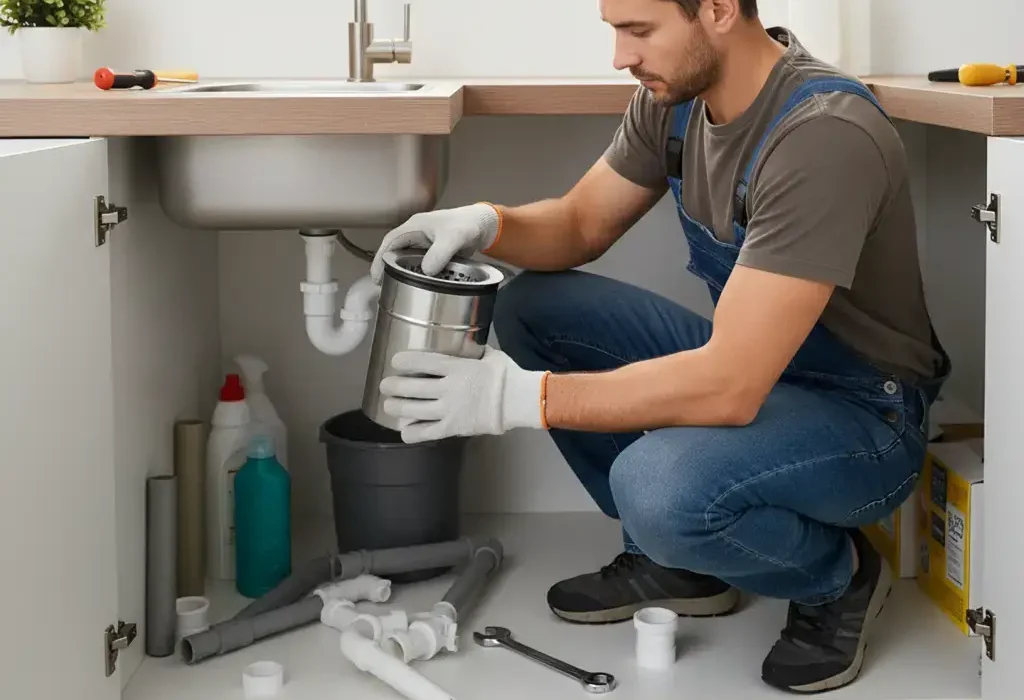
Before you begin any work, it’s important to visualize how your kitchen sink’s drainage system operates. Look under your sink and you’ll find several key components working together.
Main Drainage Components
- P-trap: The U-shaped pipe that holds standing water, creating a seal to prevent sewer gases from entering your home
- Tailpiece: The straight pipe connecting your sink or garbage disposal to the P-trap
- Discharge tube: The pipe running from the garbage disposal outlet to the P-trap inlet
- Trap arm: The horizontal section connecting the P-trap to your home’s main drain line in the wall
The garbage disposal’s job is simple: grind food waste into small particles. Water from your sink then carries these particles through the discharge tube and P-trap into the main drainage system. Understanding this flow helps you anticipate where leaks might occur during installation.
Tools and Materials Checklist
Tools (May already be in your home)
- Adjustable wrench (8-10 inch recommended)
- Slip-joint pliers
- Bucket (to catch water)
- Old towels or rags
- Hacksaw (if you need to cut PVC)
- Flashlight or headlamp
- Utility knife
Materials (Purchase from hardware store)
- 1.5-inch PVC pipes (standard for kitchen sinks)
- PVC P-trap fitting
- Slip-joint nuts and washers
- Coupling or connector fittings (as needed)
- Plumber’s putty (for sink seal)
- Teflon tape (for threaded connections)
Having everything ready before you start ensures smooth progress and prevents frustrating trips back to the store.
Safety Precautions
Protect Yourself and Your Home
- Always turn off power: Unplug the garbage disposal or switch off its circuit breaker. Even unplugged disposals can be dangerous.
- Wear protective gear: Use gloves when handling sharp pipe edges or working in tight spaces under the sink.
- Don’t overtighten fittings: Hand-tighten all connections, then use your wrench to turn them just a quarter turn more. Excessive force cracks PVC and causes leaks.
- Check material compatibility: If your old plumbing is galvanized steel or copper, verify that new PVC components are compatible. Mixing dissimilar metals creates corrosion.
- Ventilate the area: If working with PVC primer or cement, ensure good airflow.
- Keep the power off during testing: Don’t run the disposal until you’ve confirmed no leaks exist.
Step-by-Step Installation
Step 1: Turn Off Power and Water Supply
Safety first, always. Locate the garbage disposal’s power switch or circuit breaker and turn it off. Many disposals have a reset button—don’t assume the unit is inactive just because the switch is off.
Next, find the water shut-off valves under your sink (usually two small knobs or levers labeled hot and cold). Turn both clockwise until they stop. If there are no valves under the sink, you may need to shut off the main water supply to your home.
Open the sink tap to confirm water is off. Any water remaining in the pipes will drain out when you disconnect them.
Step 2: Remove the Old Drain Assembly
Prepare for water spillage. Place your bucket directly under the P-trap. Using your slip-joint pliers, grab the large slip nut (the hexagonal nut connecting the tailpiece to the P-trap) and turn counterclockwise. Don’t use excessive force—hand-tightening is often enough to break it loose.
Once the slip nut is loose, unscrew it by hand and pull the tailpiece away. Water will drain into your bucket. Remove the slip nut from the wall connection as well, and slide out the old P-trap.
Set all old components aside for recycling or disposal.
Step 3: Inspect and Clean Drain Connections
Prevention starts with cleanliness. Use your flashlight to peer into the wall drain opening. Look for mineral deposits, rust, hair, or debris. If you see buildup, use a stiff brush or cloth to gently clean it out.
Check the fitting that connects your P-trap to the wall. If it’s corroded or damaged, it may need replacement. Clean pipe connections prevent misalignment and future leaks.
Step 4: Install the Garbage Disposal Unit (If New)
Follow manufacturer instructions precisely. If you’re installing a new garbage disposal, start by removing the old one (if present). Most disposals twist-lock onto a mounting ring secured under your sink.
Install the new mounting ring according to the manufacturer’s guide. Place plumber’s putty around the sink flange to create a watertight seal, then mount the disposal unit. Hand-tighten the mounting bolts evenly—don’t over-tighten, as this can crack the sink.
Connect the power cord to a GFCI-protected outlet (near the sink). If you have a dishwasher, attach its drain hose to the disposal’s inlet using a hose clamp.
Do not plug in the disposal yet—you’ll test it after confirming no leaks.
Step 5: Connect New Pipes
Proper slope and tight connections are critical. Take your discharge tube and connect it from the disposal outlet to the P-trap inlet. Hand-tighten the slip nuts, then use your wrench to snug them (a quarter turn past hand-tight).
Ensure the trap arm slopes downward at a slight angle (about 1/4 inch drop per foot of horizontal run) toward the wall drain. This angle is essential for proper flow—water and waste must move toward the drain, not pool in the pipes.
If you’re using threaded connections, wrap the threads with Teflon tape before screwing them together. Wind the tape 3-4 times clockwise around the male threads.
Double-check all connections are hand-tight but not over-tight. PVC is durable but can crack under excessive force.
Step 6: Test for Leaks
This step prevents expensive water damage. Turn your water shut-off valves back on slowly. Run the sink tap and let water flow for 30 seconds, watching all joints carefully. Water flow problems may come from drain system — see our drain guide
Look for drips coming from:
- The slip nuts connecting tailpiece to P-trap
- The P-trap connection at the wall
- Any threaded connections
If you spot a leak, turn off the water. Tighten the affected slip nut a quarter turn at a time, then test again. If a threaded connection leaks, disconnect it, add more Teflon tape, and reconnect.
Once all connections are dry, test the garbage disposal. Plug it in, run the sink tap, and briefly activate the disposal. Listen and watch for leaks. If everything is dry and the disposal sounds normal, the installation is complete.
Troubleshooting Common Problems
Water drips from slip nuts
- Likely Cause: Nuts not tight enough or washer damaged
- Solution: Tighten a quarter turn; if leak continues, disconnect and replace washer
Water leaks at wall connection
- Likely Cause: Misaligned or corroded fitting
- Solution: Disconnect, clean both surfaces, reapply Teflon tape, reconnect
Slow draining or backups
- Likely Cause: Improper slope or clogged trap
- Solution: Check that trap arm slopes downward; remove and clean P-trap
Disposal doesn’t turn on
- Likely Cause: Power not connected or breaker tripped
- Solution: Verify outlet is powered; check circuit breaker and reset if needed
Foul smell from drain
- Likely Cause: Dry trap or food debris in disposal
- Solution: Run water to fill trap seal; grind ice cubes in disposal to clean
Maintenance and Care
Your new drain system will last for years with simple, regular maintenance.
Weekly Care
- Use cold water when running the disposal. Cold water helps solidify grease, making it grind into smaller particles that wash away more easily.
- Run water for 10-15 seconds after using the disposal. This ensures all ground waste exits the system.
Monthly Maintenance
- Clean the disposal naturally. Drop a handful of ice cubes and half a cup of baking soda down the drain, then run the disposal for 10 seconds. Follow with hot water. This removes buildup and freshens the unit.
- Visually inspect under the sink. Check for any signs of leaking (wet spots, mineral deposits, or corrosion).
What NOT to Put Down the Disposal
- Grease or cooking oil
- Fibrous foods (celery, corn husks, artichokes)
- Bones or shells
- Non-food items (plastic, metal, rubber)
- Large quantities of food at once
If prevention fails, you may need to replace drain pipes — see our guide
Frequently Asked Questions
Q: Can I do this project without prior plumbing experience?
A: Yes. This is classified as intermediate difficulty because there are several connections, but the steps are straightforward. The most important skills are using a wrench and tightening connections properly—not over-tightening. If you’re comfortable with basic hand tools, you can do this.
Q: Do I need special PVC pipes for a garbage disposal drain?
A: No. Standard 1.5-inch PVC or ABS (plastic) pipes work fine. The key is using compatible fittings for your disposal’s outlet size. Most disposals use 3.5-inch or 4-inch outlets that fit standard slip-joint fittings. Check your disposal’s documentation to confirm.
Q: What should I do if I can’t get a slip nut loose?
A: Apply penetrating oil (like WD-40) around the nut and let it sit for 15-30 minutes. This helps loosen corrosion. Then try gently tapping the nut with a hammer while turning with your wrench. Avoid striking the pipes themselves.
Q: How much does this project cost?
A: DIY materials typically cost $75-$200, depending on whether you’re installing a new garbage disposal. A basic P-trap kit runs $15-$30, while a new mid-range disposal costs $150-$400. Hiring a plumber for the same job usually costs $300-$600 in labor alone.
Q: Is it better to use PVC or metal pipes?
A: PVC is easier to work with, doesn’t corrode, and is more affordable. Metal (copper or galvanized steel) is more durable but requires soldering skills for installation. For most DIY projects, PVC is the better choice.
Q: How long should this project take?
A: Experienced DIYers typically complete it in 1.5-2 hours. If this is your first plumbing project, allow 2.5-3 hours. The testing phase shouldn’t be rushed—take time to carefully check each connection.