
When your garbage disposal hums but doesn’t spin, while the sink fills with water most homeowners think it’s broken. It almost never is.
This guide walks you through the exact troubleshooting sequence a plumber uses, in the order we use it. Try each step before moving to the next. By step 3 you’ll know whether it’s a fix-yourself job or a replacement.
Step 1: Check Power First
If flipping the switch produces no sound at all, the disposal isn’t getting electricity. Don’t open it up yet. Check these in order:
A. Press the reset button:
Look at the bottom of the disposal unit (under the sink). There’s a small red or black button — usually in the center. If the motor overheated or overloaded recently, this button popped out. Push it firmly. You’ll feel a click. Try the switch again.
B. Check the GFCI outlet or breaker:
Most disposals plug into a GFCI outlet under the sink. Look for a tripped GFCI (button on the outlet sticks out) and reset it. If your disposal is hardwired, check the dedicated breaker in your electrical panel.
C. Verify the switch works:
The wall switch or air switch might be the actual problem. Test the disposal at a known working outlet if portable, or have an electrician verify the switch with a multimeter.
Step 2: It’s Humming, the Disposal Is Jammed
A humming disposal that won’t spin means the motor is getting power, but the flywheel is locked. Something, a piece of bone, a peach pit, a coin, a teaspoon someone didn’t notice is wedged between the flywheel and the grinding chamber.
To unjam:
- Turn off power at the switch AND at the breaker:
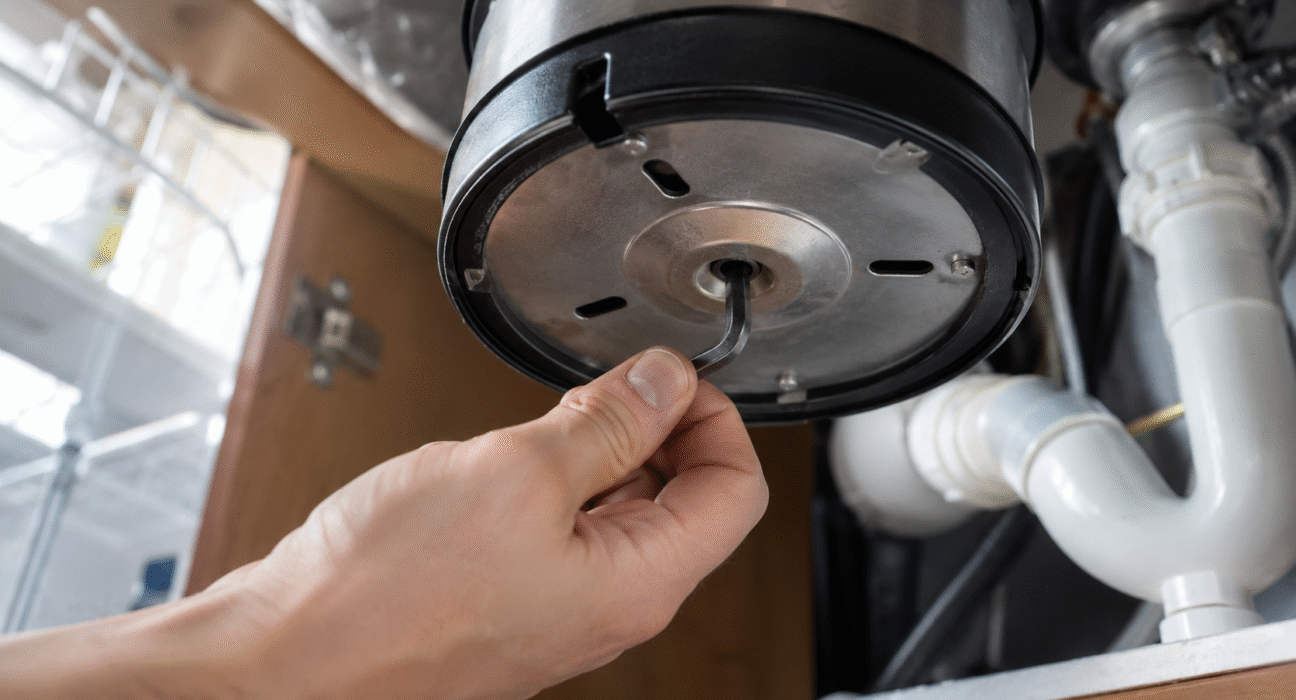
- Look in the bottom of the disposal under the sink. Most disposals have a hex-shaped recess in the very center of the bottom. This is where the allen wrench (hex key) goes.
- Insert the allen wrench (¼-inch is standard for most consumer disposals). Many disposals come with one clipped to the side; if you don’t have it, any ¼-inch hex key works.
- Crank the wrench back and forth. You’re manually rotating the flywheel through the jam. Push hard. You’ll feel resistance, then a sudden release as the obstruction breaks free.
- Continue cranking 2-3 full rotations in each direction to confirm the wheel spins freely.
- Use tongs (not your fingers, never your fingers) to remove any obstruction you can see from inside the disposal. A flashlight helps.
- Press the reset button at the bottom of the unit.
- Restore power, run cold water, and switch the disposal on briefly. If it spins normally, you’re done.
Step 3: It Spins But Sounds Wrong
If the disposal spins normally but makes a loud, irregular noise — rattling, ringing, scraping — something is still inside and getting batted around by the impellers. Common culprits: silverware, bottle caps, hard plastic.
Cut power, look inside with a flashlight, and use tongs to fish out whatever’s there. Then check whether the impellers themselves are bent or broken. Bent impellers can sometimes be straightened gently; broken ones mean replacement.
Step 4: It Spins Fine, But Water Won’t Drain
If the disposal is working but the sink isn’t emptying, the blockage is downstream — not in the disposal itself. The clog is in one of three places:
A. The dishwasher drain hose:
If your dishwasher connects to the disposal (which it does in most modern installs), check whether the small hose attached to the side of the disposal is kinked or clogged. Disconnect it (after placing a small container underneath) and clear any obstruction.
B. The disposal’s outlet pipe:
The horizontal pipe leaving the side of the disposal often clogs with grease and ground food. Unscrew the slip-nut connecting it to the wall drain, pull the pipe off, and check.
C. The P-trap or drain line beyond:
The U-shaped P-trap under the sink catches debris. Disconnect both slip nuts, pull the trap off, dump and rinse, then reinstall. If that’s clear too, the clog is further into the wall — try a hand-crank drain snake through the wall stub.
Step 5: It’s Leaking — Where?
Leaks are diagnosed by location. Dry the area completely, run the disposal with water, and watch where moisture first appears.
- Leak from the top (sink flange) → the plumber’s putty seal between the disposal and the sink has failed. Disassemble, reseal with fresh putty.
- Leak from the side (dishwasher inlet) → loose hose clamp or cracked nipple. Tighten or replace.
- Leak from the side (drain outlet) → loose slip-nut connection. Hand-tighten, then add ¼ turn with channel locks.
- Leak from the bottom → internal seal failure. The disposal has reached end of life. Replace it.
How to Make Your Disposal Last Longer
A disposal’s average lifespan is 8-12 years. Habits that shorten that:
- Grinding fibrous foods (celery, corn husks, onion skins, banana peels) — they wrap around the impellers.
- Grinding starchy foods (potato peels, pasta, rice) — they turn to paste and clog the trap downstream.
- Grinding bones and pits — the disposal CAN handle small bones, but pits and large bones are flywheel jammers.
- Using hot water while grinding — solidifies grease in your drain line. Always use cold water.
- Putting grease down the disposal — same reason. Grease should always go in the trash.
- Forgetting to run water during AND for 15 seconds after grinding — debris sits in the trap if you stop water too soon.
Frequently Asked Questions
Why is my garbage disposal humming but not working?
The motor is getting power but the flywheel is jammed — usually by a piece of food, a utensil, or a hard object. Cut power, use an allen wrench in the hex slot on the bottom to manually rotate the flywheel and free the obstruction, then press the reset button.
Where is the reset button on a garbage disposal?
On the bottom of the disposal unit, accessible from under the sink. It’s a small red or black button, usually in the center. If the disposal overheated or overloaded, this button pops out. Push it firmly to reset.
Will chemicals damage my garbage disposal?
Yes. Chemical drain cleaners can corrode the disposal’s seals, splash guard, and internal components. Use ice cubes for cleaning the chamber, vinegar and baking soda for odor, and a hand crank or plunger for clogs. Avoid pouring drain chemicals into a sink with a disposal.
How long does a garbage disposal last?
8-12 years for an average residential unit. Heavy use, frequent grease/grease food disposal, and hard water can shorten that to 5-7 years. Premium 1 HP+ models with stainless components last toward the longer end.
Can I run my dishwasher if my garbage disposal is broken?
Only if the dishwasher drains independently. Most modern dishwashers drain through the disposal — if the disposal is jammed or clogged downstream, your dishwasher will back up. Fix the disposal first.
What should I never put down a garbage disposal?
Fibrous foods (celery, onion skins, corn husks), starchy paste-forming foods (potato peels, rice, pasta), grease, bones larger than 1 inch, fruit pits, eggshells (debated, but they create grit), and obviously anything non-food.
Final Word
A garbage disposal humming or not working is almost always a 5-minute fix with a $2 tool. The allen wrench trick frees most jams, the reset button restores power after an overload, and a flashlight plus tongs handles foreign objects. The few cases that aren’t DIY — burnt motor, bottom-side leak, 10+ year old unit are usually obvious. When in doubt, kill the power before reaching into the chamber, and never use your hand to clear an obstruction.