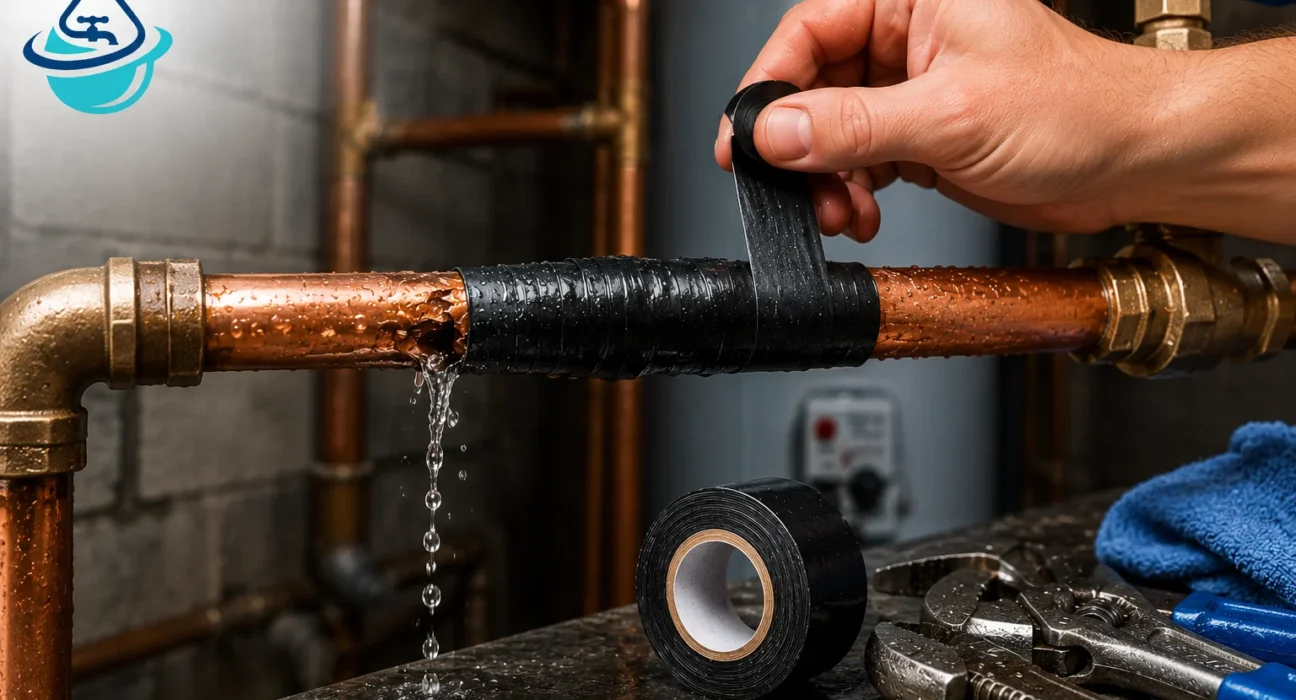
A leaking pipe can cause more issues than most homeowners expect. Homeowners in the USA often wait for plumbers for days or even weeks, and during that time a small leak can lead to water damage, mold growth, higher utility bills, and costly repairs throughout the home.
In this blog, we have mentioned and explained the three main types of waterproof tape for leaking pipes. These are self-fusing silicone tape, butyl rubber tape, and fiberglass wrap. We also look at the weather in different parts of the USA, like the cold North, the hot and dry Southwest, and the wet South. Based on all of this, we then recommend the best tape for homeowners based on their pipe type, leak situation, and local climate conditions.
And one honest note up front: waterproof tape is a temporary or semi-permanent fix, not a forever solution. It’s the smartest thing you can do at 11 p.m. on a Sunday. It is not a substitute for a proper repair on a pressurized line inside a finished wall.
Three Types of Pipe Repair Tape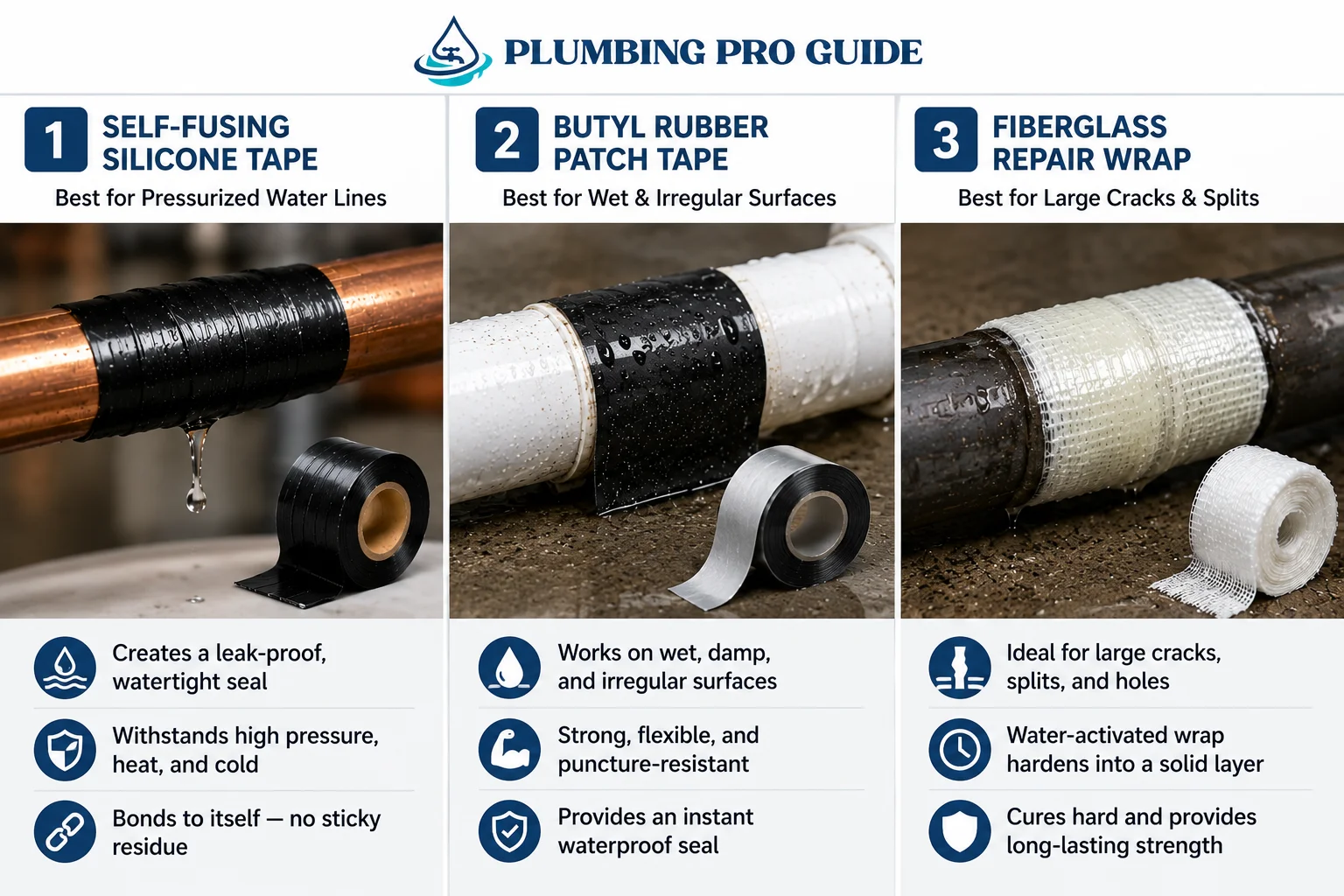
1. Self-Fusing Silicone Tape:
This is the one most plumbers reach for on pressurized lines. It has no adhesive at all. Instead, the silicone chemically bonds to itself as you wrap, fusing within minutes into a single seamless rubber sleeve around the pipe.
How it performs:
Excellent on smooth metal and plastic supply lines. Stretches tight to conform to the pipe, so it grips with mechanical pressure, not glue.
Temperature range:
Typically about −60°F to 500°F (some rated wider), which is why it’s the only reliable choice near water heaters and on hot-water lines.
Pressure handling:
High tensile strength — quality rolls are built to withstand serious pressure, making them suited to residential supply lines (40–80 psi) and beyond.
Cleanup:
Leaves zero residue and peels off cleanly later.
Catch:
It needs a dry surface to fuse properly, and it bonds to itself — not to the pipe — so you must wrap with tension and good overlap.
Reach for it when:
The pipe is pressurized, hot, copper or PEX, or you want a clean, longer-lasting temporary seal.
2. Butyl Rubber / Rubberized Patch Tape:
This is the Flex Tape / Gorilla / T-Rex category. These use a thick, aggressive adhesive that sticks on contact to almost any surface, including rough, dirty, and slightly damp ones.
How it performs:
Great instant tack on irregular shapes, drain fittings, gutters, and corroded surfaces where silicone can’t get a clean wrap.
Temperature range:
Good for ambient and cold, but the adhesive can soften and creep in sustained heat — a real problem near water heaters and in hot attics.
Pressure handling:
Best on low-pressure drain/waste lines and surface patches. On a high-pressure supply line it’s a short-term measure at most.
Cleanup:
Can leave residue and may pull paint or finish when removed.
Reach for it when:
The surface is wet, rough, or oddly shaped, the line is low-pressure (drains, gutters), or you need to grab a leak instantly before you can dry it.
3. Water-Activated Fiberglass Repair Wrap:
It is less famous but it use for bigger problems. You soak the wrap (or it activates on contact with water), wrap the pipe, and a resin cures into a hard, rigid fiberglass shell in minutes.
How it performs:
Stronger and more rigid than either tape above. Bridges larger cracks and splits and tolerates higher pressure as a stopgap.
Best for:
A split that’s too big for tape, or when you need maximum hold until a plumber arrives.
Catch:
Once it cures, it’s hard it’s a true stopgap to be cut off and replaced later, not a flexible patch.
Tape which is not for Leaking Purpose:
PTFE:
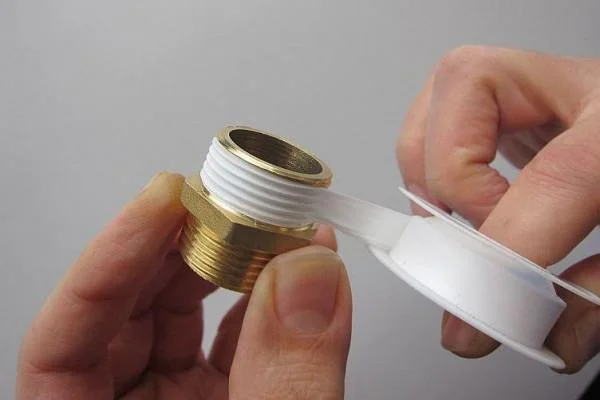
That thin white tape on the spool labeled plumber’s tape or PTFE / Teflon tape is not a leak-repair tape. It seals the threads of a connection before you screw it together so the joint doesn’t leak. Wrapping it around the outside of a leaking pipe body does nothing. If you came here looking to patch a hole, you want silicone or butyl tape not PTFE.
How U.S. Weather and Your Region Change the Right Choice
Cold North, Midwest & Northeast — the freeze-burst belt
Across the northern tier, the #1 cause of pipe leaks is freezing. When water freezes it expands and splits the pipe; the leak shows up when it thaws. Most freeze damage happens in unheated zones basements, crawl spaces, attics, garages, and exterior walls — during the December-to-February deep freeze.
Best choice: Self-fusing silicone tape.
It stays flexible in the cold and won’t get brittle, and butyl adhesives are less reliable on a cold, possibly damp pipe.
Reality check:
Tape on a thawed, burst pipe is a bridge to a real repair, not the repair. A freeze split is usually too clean and too long for tape to hold under pressure for long. Wrap it, get the water flowing if you must, and schedule the fix.
Prevention pays:
Once you’re patched, insulate vulnerable pipes and learn to prevent frozen pipes so you’re not back here next January.
Hot, Arid Southwest — Arizona, Nevada, Texas, inland California
- Attics hit brutal temperatures, water-heater closets stay hot, and hot-water lines run constantly warm.
- Butyl adhesive softens and creeps in sustained heat, so a patch tape near a water heater or in a hot attic can slowly fail.
- Much of the Southwest has very hard water that accelerates corrosion and pinhole leaks in copper. A silicone sleeve is a solid stopgap over a corroded section — but recurring pinholes mean the pipe itself is going
Humid Southeast & Gulf Coast — Florida, Louisiana, coastal Texas
High humidity and constant condensation mean pipes are often damp on the outside even when they aren’t leaking.
Best choice:
This is where butyl rubber patch tape earns its keep its aggressive adhesive grabs a damp or sweating surface that silicone would struggle to bond to. Still dry the pipe as much as you can first.
Outdoor lines:
For exposed pipe, hose bibs, and irrigation in the relentless sun, pick a UV-resistant tape (T-Rex is built for this). Plain tape degrades in direct sunlight.
Storm season:
After a hurricane or major storm, treat any tape patch as strictly temporary until the line can be inspected.
Pacific Northwest & coastal regions
Mild temperatures but persistent moisture and salt air (near the coast) drive corrosion. Dry the pipe, then either type works; lean toward silicone on metal supply lines and butyl on damp, irregular drain fittings. Use UV-resistant tape on anything outdoors.
Standard U.S. residential water pressure runs 40–80 psi. Above 80 psi is considered high and stresses both pipes and any tape seal — most plumbing codes require a pressure-reducing valve at that point. If your tape keeps failing on a supply line, test your home’s pressure; chronically high pressure may be the real culprit, and a $40 gauge will tell you in two minutes.
Match the Tape to Your Pipe Material
The pipe in your hand changes what sticks. Here’s a quick reference for common U.S. plumbing materials.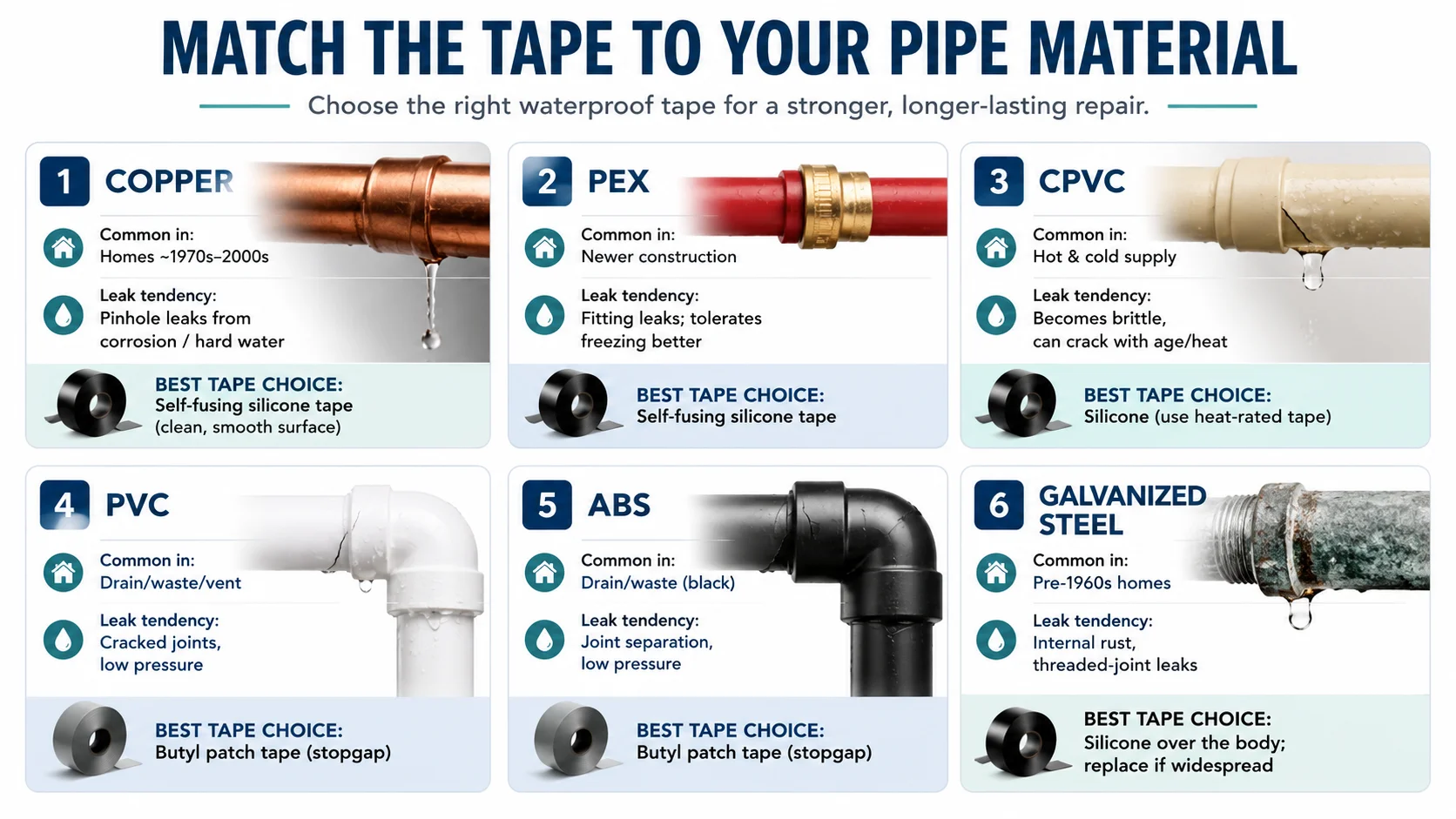
| Pipe Material | Common in | Leak tendency | Best tape choice |
|---|---|---|---|
| Copper | Homes ~1970s–2000s | Pinhole leaks from corrosion / hard water | Self-fusing silicone (clean, smooth surface) |
| PEX | Newer construction | Fitting leaks; tolerates freezing better | Self-fusing silicone |
| CPVC | Hot & cold supply | Becomes brittle, can crack with age/heat | Silicone (use heat-rated tape) |
| PVC | Drain/waste/vent | Cracked joints, low pressure | Butyl patch tape (stopgap) |
| ABS | Drain/waste (black) | Joint separation, low pressure | Butyl patch tape (stopgap) |
| Galvanized steel | Pre-1960s homes | Internal rust, threaded-joint leaks | Silicone over the body; replace if widespread |
Top Waterproof Tape Recommendations
Here is the right pick for each real situation, with what to actually look for.
Best Overall for Pressurized Supply Lines — Self-Fusing Silicone Tape
(Rescue Tape, X-Treme Tape, XFasten, and similar)
The default choice for copper and PEX supply lines, hot-water lines, and anything under pressure. Look for a roll rated to roughly −60°F to 500°F, with UL 510 listing and a stated high tensile strength. Comes in 1-inch widths and 10–36 ft rolls.
Why it on priority:
Flexible, heat-proof, no residue, and it forms a true bonded sleeve rather than relying on glue.
Approx. price:
$10–$16 a roll.
Best for Wet, Rough, or Irregular Surfaces — Butyl Patch Tape
(Gorilla Waterproof Patch & Seal, T-Rex Flexible Waterproof Tape)
When you can’t get a clean dry wrap a sweating drain fitting, a corroded elbow, an odd shape, the aggressive adhesive grabs where silicone can’t. Excellent for low-pressure drains and gutters.
Approx. price:
$9–$15.
Best for Outdoor & UV Exposure — T-Rex Flexible Waterproof Tape
Built to resist sunlight and weather, with “flex-to-fit” conforming and strong adhesion to concrete, metal, and plastic. The pick for hose bibs, irrigation lines, and any exposed outdoor pipe.
Best for a Larger Split (Stopgap) — Water-Activated Fiberglass Wrap
(pipe repair bandage / fiberglass wrap kits)
When the damage is too big for tape, this cures into a rigid shell that holds higher pressure until a plumber can replace the section.
Flex Tape
Flex Tape is the most-marketed name in the category, and it does have a place, low-pressure patches, irregular surfaces, and quick stop the drip jobs where you can press it down firmly. But the demo-video reputation oversells it. On hot lines the adhesive can soften, and on a pressurized supply line it’s a short-term measure at best. For those jobs, silicone outperforms it. Use it for what it’s good at and don’t trust it on pressure or heat.
Side-by-Side Comparison
| Type | Best for | Temp range | Pressure | Works on damp? | Residue | Approx. price |
|---|---|---|---|---|---|---|
| Self-fusing silicone | Supply lines, hot lines, copper/PEX | ~−60°F to 500°F | High | Best dry | None | $10–$16 |
| Butyl patch (Gorilla/T-Rex/Flex) | Drains, gutters, irregular/wet | Cold–moderate (softens in heat) | Low | Yes (good tack) | Some | $9–$15 |
| Fiberglass wrap | Larger splits, higher-pressure stopgap | Wide | High (stopgap) | Activates wet | Rigid shell | $12–$20 |
| PTFE (“plumber’s tape”) | Sealing threaded joints only | — | — | — | None | $1–$4 |
How to Apply Waterproof Tape So It Actually Holds
1- Shut off the water and relieve pressure:
Close the nearest shutoff or the main, then open a faucet downstream of the leak to drain the line and drop the pressure. You cannot reliably seal a pressurized, spraying pipe.
2- Clean and dry the pipe:
Wipe away water, dirt, oil, and corrosion. Degrease if you can. Silicone needs a dry surface to fuse. If it’s a butyl patch, get it as dry as possible for best adhesion.
3- Start about 1 inch before the leak:
Don’t begin wrapping right on the hole — start your first wrap roughly an inch ahead of it, on solid, undamaged pipe. This gives the tape a clean, stable section to anchor to before it ever reaches the leak, so the seal is built on a strong foundation instead of starting on the weak spot. Wrapping out from good pipe on both sides of the damage also spreads the pressure across a wider area, which is exactly what keeps the patch from lifting or blowing out once the water’s back on.
4- Wrap with tension and overlap:
For self-fusing silicone, stretch the tape to about 75% of its limit as you wrap and overlap each pass by 50%. The tension and overlap are what create the seal wrapping it loose is the #1 mistake. Continue about 1 inch past the leak, then add a few more tight passes over the leak itself.
5- Press and finish:
For silicone, squeeze the wrap so it fuses. For butyl patch tape, press and burnish it down hard, smoothing the edges so water can’t lift them.
Common mistakes that cause failure:
-
- Not enough tension or overlap (the seal never forms)
-
- Wrapping a wet pipe with silicone
-
- Trying to seal an actively pressurized, spraying line
-
- Too little coverage past the leak
-
- Using a heat-softening butyl adhesive next to a water heater
How Long Will the Repair Actually Last?
-
- Self-fusing silicone on a clean, dry pinhole, low-to-normal pressure: can hold for weeks to months (semi-permanent). Still schedule the real repair.
-
- Butyl patch on a low-pressure drain: reliable for a good while; on a hot or pressurized line, expect days to weeks at most.
-
- Fiberglass wrap: strong as a stopgap but meant to be cut off and replaced.
Frequently Asked Questions
Does waterproof tape work on a pressurized water line?
Yes, as a temporary fix if you choose the right tape and apply it correctly. Self-fusing silicone tape is the best option for pressurized supply lines because it forms a tight, bonded sleeve. Shut the water off, drain and dry the pipe, and wrap with firm tension and 50% overlap. It’s a stopgap, not a permanent repair.
Can I use waterproof tape on a hot water pipe?
Only self-fusing silicone tape, which is rated to around 500°F. Avoid butyl/rubber adhesive tapes (like Flex Tape) on hot lines or near a water heater, because the adhesive can soften and the seal can creep or fail.
Will tape stop a leak permanently?
No. Waterproof repair tape is a temporary or semi-permanent solution. It’s excellent for stopping a leak right away and buying time, but a pressurized line — especially inside a wall should be repaired properly with the correct fitting or by a plumber.
Can you apply waterproof tape to a wet or actively leaking pipe?
It’s far better to dry the pipe first. Silicone tape must be dry to fuse. Butyl patch tapes have aggressive adhesive that can grab a damp surface in a pinch, but adhesion is always better dry. If you can’t stop the drip, plug it with epoxy putty or a clamp, dry the area, then wrap.
What’s the difference between plumber’s tape and waterproof repair tape?
Plumber’s tape (PTFE/Teflon) seals the threads of a joint before assembly — it’s not for patching holes. Waterproof repair tape (silicone or butyl) is designed to seal an existing leak on the body of a pipe. They’re not interchangeable.
How long does self-fusing silicone tape last?
On a clean, dry, low-to-normal-pressure pipe it can last weeks to several months, and it reaches full strength about 24–48 hours after application. Heat, high pressure, and vibration shorten that. Treat it as a reliable temporary fix.
Is waterproof tape safe for drinking-water (potable) pipes?
Tape wraps the outside of the pipe, so it doesn’t contact your drinking water and is fine as an external patch. It is not a long-term solution for potable-line integrity — restore the pipe properly with approved materials.
What tape should I use on a frozen or burst pipe?
Once thawed, use self-fusing silicone tape because it stays flexible in the cold. Understand that a freeze burst is usually a clean split that’s hard to hold under pressure — tape is a bridge to a real repair, so get the pipe fixed and insulate it to prevent a repeat.